
Check Engine Light: What It Means and What to Do
Is the check engine light on? We explain the difference between a steady and a flashing light, the most common causes, and when you really need to head to a garage.
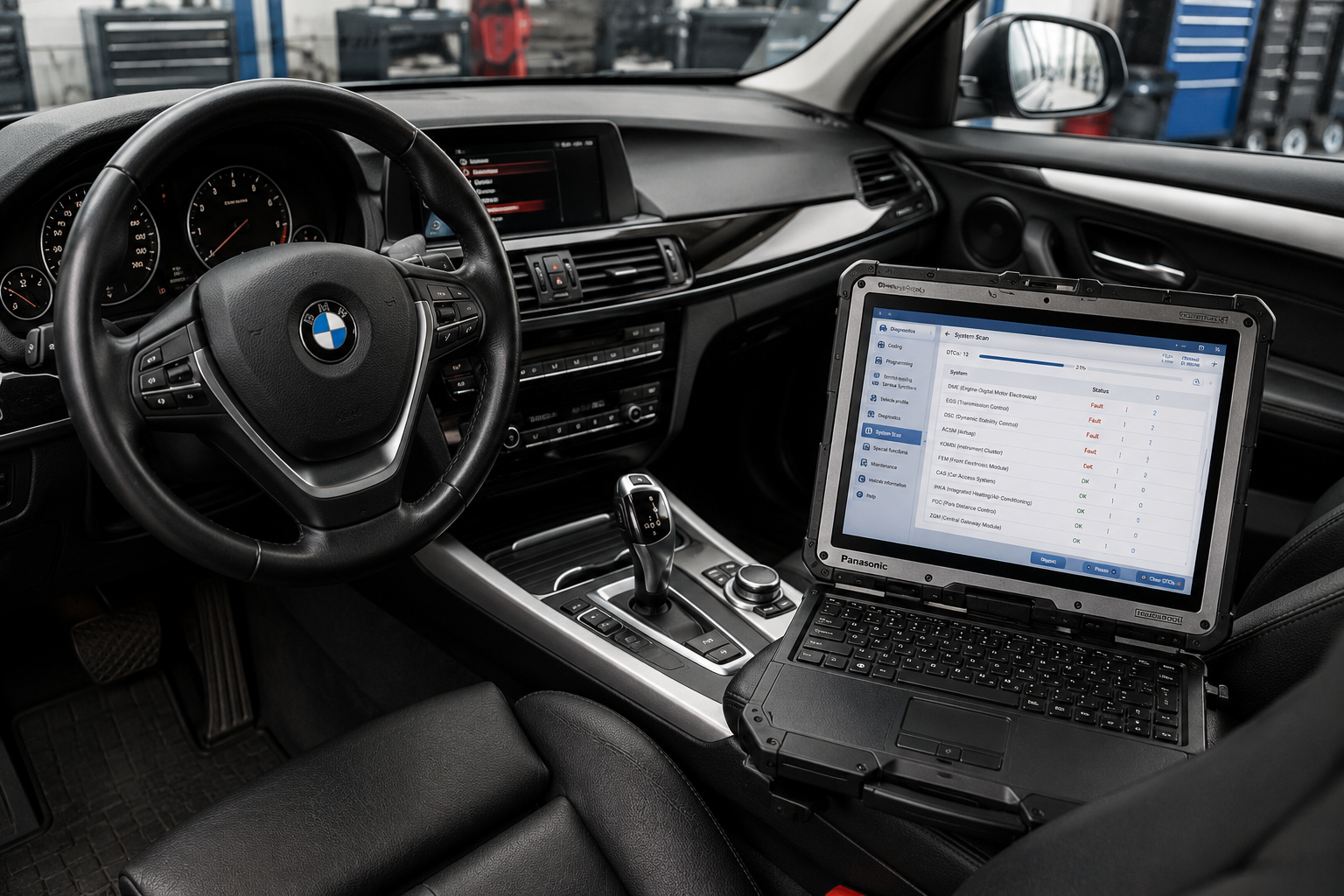
What the check engine light actually means
The orange engine symbol on the dashboard (sometimes labelled "Check" or "Engine") is a message from the engine control unit. It means one of the sensors or systems has reported a reading outside the normal range, and a fault code has been stored in memory.
This is an important distinction: the light itself doesn't tell you what broke. It only tells you it's worth plugging in a diagnostic scanner and reading the stored code. The same symbol can point to an 80 PLN trifle or the start of a serious fault.
Steady light or flashing light
- Steady orange: the fault has been logged, but it usually isn't an immediate threat to the engine. You can drive calmly to a garage, avoiding hard acceleration and high revs.
- Flashing: a serious signal, most often a misfire. Unburnt fuel then reaches the catalytic converter and can overheat and destroy it within a matter of minutes. Slow down, keep the revs low, pull over at the first opportunity and call a garage.
The most common causes
In practice, most cases end with a cheap repair. The usual culprits are:
- worn spark plugs or ignition coils (misfires, jerking),
- the lambda sensor, i.e. the oxygen sensor in the exhaust (a common fault after 150,000–200,000 km),
- the mass air flow sensor (MAF), especially after a poorly done air filter change,
- an EGR valve clogged with carbon deposits,
- the diesel particulate filter (DPF) in diesel engines,
- the crankshaft or camshaft position sensor,
- reduced catalytic converter efficiency,
- on older cars, even a loose fuel filler cap.
Sample fault codes
| Code | Meaning |
|---|---|
| P0300–P0308 | Misfire (general or in a specific cylinder) |
| P0420 / P0430 | Low catalytic converter efficiency |
| P0401 | Insufficient EGR flow |
| P0130–P0167 | Lambda sensor fault |
| P0101 / P0102 | Faulty mass air flow (MAF) signal |
A code only points to the area of the problem, though, not its cause. For example, P0420 doesn't always mean a worn catalytic converter. The culprit could just as easily be the lambda sensor or an exhaust leak that distorts the reading.
What you'd better not do
- Don't clear the code "blind". Turning the light off without fixing anything means the problem comes back, and in the meantime you can damage pricier parts such as the catalytic converter or the DPF.
- Don't ignore a flashing light. A dozen or so minutes of driving with a misfire can destroy a catalytic converter, and replacing it costs many times more than a set of spark plugs or a coil.
- Don't assume the worst. Panic doesn't help. Statistically, it's most often a spark plug, a coil or a sensor.
What to do, step by step
- Check whether the light is steady or flashing.
- Watch for the symptoms: power loss, jerking, smoke from the exhaust, a smell of fuel, higher fuel consumption, unusual noises.
- With a steady light and the engine running normally, you can drive to a garage at an easy pace.
- With a flashing light or a clear loss of power, keep driving to a minimum and book diagnostics as soon as possible.
- Make a note of when and under what circumstances the light came on. That genuinely shortens the time it takes to track the fault down.
Can you drive with the light on?
That depends on how the light behaves and how the car behaves.
- Steady light, engine running smoothly, power unchanged: you can drive home and book diagnostics in the coming days. Just avoid long trips and hard acceleration.
- Steady light, but the car jerks, hesitates or loses power: keep driving to a minimum and get it looked at sooner.
- Flashing light: treat it as an alarm. Drive slowly, at low revs, and stop as soon as you can.
It also happens that the light goes out on its own after a few engine starts. That doesn't mean the problem is gone. The fault code stays in the control unit's memory as a so-called stored fault, and it's still worth reading, because the fault usually comes back.
Diagnostics at Twin Torque Service
At our garage in Targówek, at ul. Chodecka 1D in Warsaw, we start with a full read-out of the control units, but we don't stop at displaying a code. A code is a starting point, not a verdict. We check live parameters, compare sensor readings and verify whether a part is genuinely faulty before we suggest replacing it.
Computer diagnostics start from 100 PLN, and once we've read the faults we always give you a repair quote before any work begins. That way you're not paying to replace parts "blind".
Summary
- Check engine is a prompt for diagnostics, not a diagnosis in itself.
- Take a flashing light seriously and keep driving to a minimum.
- Don't clear the code without fixing the cause.
- The sooner you come in for a read-out, the cheaper the repair usually turns out to be.
Need a consultation?
Need diagnostics or a price estimate? Contact us.